E-Challan Karachi Check by Vehicle Number – Complete Online Guide 2025
Karachi operates a modern, technology-driven traffic enforcement system that uses automated cameras to detect violations and issue E-Challans digitally. Managed by the Sindh Police Traffic Department under the Sindh Safe City & Smart Traffic Management Project, the system integrates CCTV surveillance, Automatic Number Plate Recognition (ANPR), AI analysis, and government databases to ensure transparent and accurate law enforcement.
This fully automated process minimizes human error, increases compliance, and improves road safety across the city.
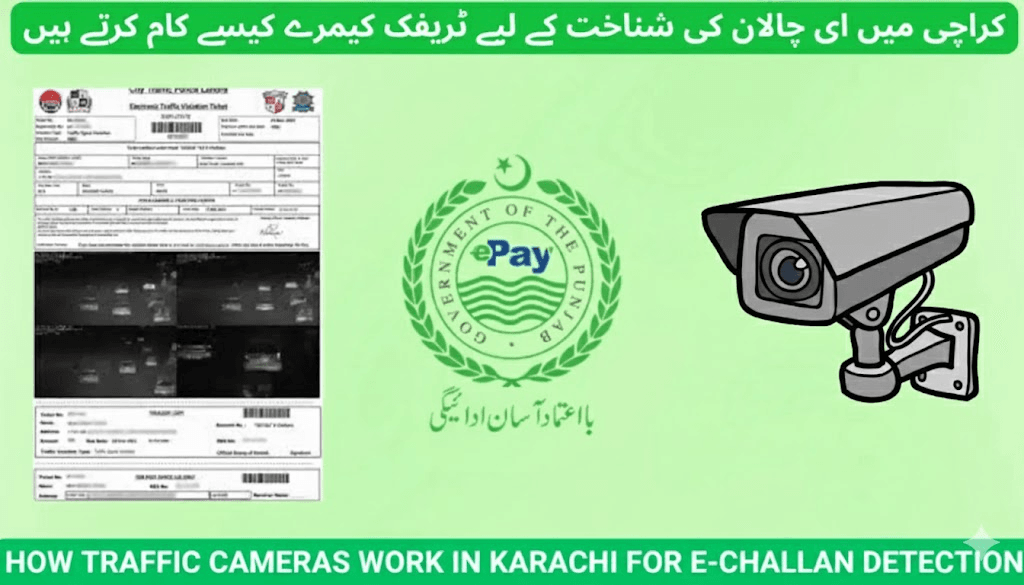
How Traffic Cameras Work in Karachi for E-Challan – 2025
Understanding the Karachi Traffic Camera System
The Karachi traffic camera network operates citywide, covering:
- Major intersections
- Traffic signals and flyovers
- High-traffic corridors
- Commercial and accident-prone zones
Cameras are installed along important routes including Shahrah-e-Faisal, MA Jinnah Road, University Road, Korangi Road, Clifton, DHA, and Saddar.
These cameras record vehicle movement around the clock. When a violation occurs — such as signal jumping or overspeeding — the system automatically captures the incident and links it with vehicle ownership data from the Sindh Excise and Taxation Department for challan issuance.
Technology Behind E-Challan Detection in Karachi
Karachi’s E-Challan program uses multiple integrated technologies working together through centralized digital platforms.
1. Automatic Number Plate Recognition (ANPR)
ANPR is the foundation of the detection system.
- AI-powered optical recognition scans vehicle number plates
- Plate numbers are automatically converted into digital data
- Details are matched against the Excise database
- The registered vehicle owner’s information is retrieved immediately
Once verified, the system initiates challan generation.
2. CCTV Surveillance Network
A large network of high-resolution CCTV cameras streams live footage to the traffic monitoring centers.
Cameras cover:
- Signal junctions
- Flyovers and underpasses
- Highways and arterial roads
- Commercial areas
The cameras allow:
- Real-time detection
- Remote verification by traffic authorities
- Evidence recording and archiving
3. Sindh Police Command & Control Integration
All camera feeds and detection data converge at the Integrated Command and Control Center (IC3) operated by Sindh Police.
The IC3:
- Monitors live footage
- Validates automated detections
- Analyzes traffic flows
- Approves violation tagging before challan issuance
This layer ensures accuracy while keeping the system mostly automated.
4. Database Link with NADRA & Excise
After a violation is captured, the system connects to:
- Sindh Excise & Taxation Department — for vehicle registration details
- NADRA — for link verification of CNIC and registered ownership
This integration ensures e-challans are sent only to the correct legal owner of the vehicle.
Step-by-Step: How the E-Challan Process Works
Step 1 — Violation Detection
A vehicle breaks a traffic rule (overspeeding, jumping signal, lane violation, etc.). Cameras record precise video evidence.
Step 2 — Plate Scanning
The ANPR module extracts the number plate automatically from the video footage.
Step 3 — Database Verification
The number plate is matched with government vehicle ownership databases to retrieve:
- Owner name
- CNIC
- Registered address
- Contact details
Step 4 — E-Challan Generation
A digital challan is created containing:
- Vehicle registration number
- Type of violation
- Date & time of incident
- Capture location
- Fine amount
- Photo or video evidence
Step 5 — Notification
The challan is:
- Uploaded instantly to the official portal
https://echallan.sindhpolice.gov.pk - Delivered via SMS alerts and sometimes postal notice
Step 6 — Payment & Status Update
- Payment can be made via 1Link banks, ATMs, online portals, or banking apps
- Once paid, the challan status automatically updates to PAID
Violations Detected by Karachi Traffic Cameras
| Violation Type | Detection Method |
|---|---|
| Red-light jumping | Signal sensor + camera trigger |
| Overspeeding | Radar and speed-tracking cameras |
| Wrong-lane driving | AI motion tracking |
| One-way violation | Route flow analysis |
| Mobile phone use | Visual AI behaviour detection |
| Seat-belt violation | Image recognition analysis |
| Helmet violation | Object & facial detection |
Each confirmed violation triggers automatic challan generation without traffic wardens stopping vehicles on roads.
Benefits of the Camera-Based E-Challan System
Transparent Enforcement
All challans include photo or video evidence, removing any ambiguity or dispute risks.
Bias-Free System
No physical interaction means no selective enforcement or corruption.
Faster Processing
Fines are generated within minutes of a violation.
Convenient Payments
Multiple digital and banking channels enable instant settlement.
Improved Road Safety
Consistent detection leads to stronger compliance and accident reduction.
Challenges & System Limitations
Despite strong performance, ongoing challenges include:
- Old or incorrect ownership data in registration records
- Altered or fancy number plates lowering ANPR accuracy
- Limited public understanding of online challan tracking
- Temporary camera network outages during upgrades or technical maintenance
Sindh Police continues to expand camera coverage and train AI algorithms to improve plate-reading and misuse detection.
Future of Traffic Camera Enforcement in Karachi
The Karachi Safe City expansion plan (2025–2026) includes:
- Full AI-driven behavioral detection
- Mobile app notifications for violators
- License point-deduction integration
- Facial recognition for wanted vehicle tracking
- Real-time traffic analytics dashboards
These upgrades are intended to align Karachi with global smart-city traffic enforcement standards.
Frequently Asked Questions (FAQs)
1. Which technology is used for detection?
ANPR cameras, CCTV surveillance, radar speed sensors, and AI tracking systems.
2. How do cameras identify violations?
Through automated monitoring that flags red-light jumps, speed limit breaches, lane violations, helmet absence, and mobile usage.
3. Where are cameras installed?
Across major Karachi routes, including Shahrah-e-Faisal, MA Jinnah Road, University Road, Korangi Road, Clifton Block areas, DHA, and Saddar.
4. Can I view violation evidence?
Yes. Photo proof is available on the official portal:
https://echallan.sindhpolice.gov.pk
5. Who manages the system?
The Sindh Police Traffic Department, working with Excise & Taxation Sindh and NADRA.
6. How can I pay my E-Challan?
Through any 1Link-connected ATM, bank branch, mobile banking app, or official portal payment channels.
7. What if I receive a wrong challan?
You may lodge a complaint with:
- Sindh Police Complaint Cell
- Traffic Police Headquarters Karachi (with evidence)
Final Conclusion
The adoption of advanced traffic cameras and automated E-Challan detection has modernized traffic enforcement in Karachi. Using ANPR systems, AI surveillance, and centralized database verification, Sindh Police now operate a transparent, evidence-based digital law-enforcement network.
As more cameras and AI tools are added, the system will provide improved accuracy, reduced manual interference, and safer roads for all Karachi residents.